Accuracy Under Stress
Performing under extreme stress in real-life shooting situations
by Dave Brown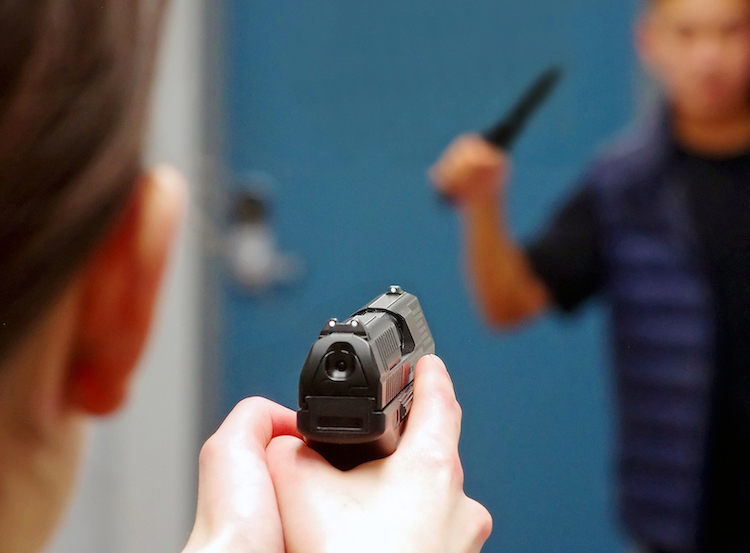
“Knowledge is not skill. Knowledge plus ten thousand times is skill.”
- Shinichi Suzuki, Japanese violinist and composer
Stress is high, adrenalin is pumping and a grey fog is clouding your peripheral vision. Your hands shake as you grip your pistol and you know the moment is about to come when you must pull that trigger. This is suddenly nothing like a Hollywood movie. This is real life, and in real life the good guys don't always hit and the bad guys don't always miss.
You trained hard for this, and your qualification scores reflect that. This is the moment when accuracy is most critical. De-escalation strategies didn't work; you have run out of options, and lives are on the line. But unlike even the most dynamic training, your arousal level is heading off the charts. You are now WAY past the peak of a bell curve that graphically shows performance versus arousal and you are about to figuratively fall off the front of a very steep slope.
So why does accuracy deteriorate so rapidly in real-life situations for even the most well-trained professionals? Well, you probably will never meet psychologists Robert Yerkes and John Dodson in court and you won't read their names in any consolidated law books, but you are about to experience what is referred to as The Yerkes-Dodson Law.
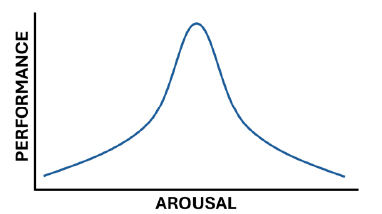
Whether you call it anxiety, arousal, fear or stress, it basically means that performance can actually improve with an increased state of arousal but then it tends to deteriorate rapidly if the arousal increases beyond the peak. This is what I call the “back side” of the curve … and there is not much you can do at this instant to bring your stress level down. This is the reason why long-term statistics show how even well-trained officers tend to miss with over half their shots in the chaos of actual encounters.
Shooting from the Head
Thankfully, bad guys don’t read statistics. I don’t think they read too many textbooks either.
This may be good because one of the problems with dealing with the curve of performance versus arousal is that there may be hundreds of books and articles on how to reduce that stress to maintain peak performance, but little is written on how to achieve the best accuracy possible when you are at the extreme end of the arousal curve. Pulling that trigger is going to alter many lives forever, and all the articles and books in the world can't help you reduce that stress.
Sport Psychology teaches how to manage that stress, but this is not about managing stress. This is about how to perform with accuracy even though you are suddenly under what may be the highest state of arousal in your life. What you have done in training is now going to affect how well you can perform when performance may predictably be at its lowest.
I call this “shooting from the head.”
The human brain has an amazing capacity to function even in stressful situations, but in a sudden life-threatening situation, that capacity to consciously focus attention on everything at once becomes limited. This is why it is so important to imprint the basic skills into the unconscious side of the brain. When attention is a limited resource; the processing of information becomes incomplete, and the result is this immediate decrease in performance.
When justification, background, location of backups, or searching for cover, all start demanding attention, there is less capacity to process the basic skills. Much like a computer with a limited amount of memory, devoting a lot to one set of tasks slows down the others. This is why pistol training uses constant repetition to focus on the six basic skills: grip, stance, sight picture, trigger control, draw from the holster, and reloading. This means that when limited conscious attention is needed to process external or complex information, the technical part of shooting comes from the subconscious part of the brain.
The key then is to make sure those six basic skills are practiced until they become automatic reactions and don't demand a major portion of our brain's conscious attention. Ever heard the expression "muscle memory"? Well, muscles don't have a memory. Your brain has a memory. Practice basic technical skills enough times to imprint those actions into the unconscious part of the brain. THAT is "memory."
When was the last time you spent time on dry-fire drills? Most officers devote very little time to dry-fire, but if you have a place to practice and you follow strict safety rules, there is nothing better than dry-fire practice to show you exactly how good your trigger control is. Aim is nothing without trigger control.
If you are using iron sights, watch the relationship of the front sight to the notch when the striker falls. If using a red dot, watch the movement of the dot at the instant the trigger is pulled. If that sight or dot is shaking side-to-side, even slightly, it means you need to work on your grip. Loosen up your strong hand and squeeze more with the support hand. If that dot or sight starts dipping as you pull the trigger, you are anticipating the recoil. The cure for that, is simply LOTS more dry-fire practice.
It's not just trigger control you are practicing. Unless your pistol has a second-strike capability, the action of bringing the pistol down slightly – to what is sometimes called the ‘workbench’ position – and then racking the action on an empty chamber to re-cock the pistol and raising it up to firing position, over and over, also reinforces your basic draw movements and it imprints the action of reloading into your unconscious mind.
Stop Chasing Tends
In training, we often see something “new” or “Improved” that comes along every few years. It’s not always some laughably bad technique like the so-called center-axis relock (CAR) method of shooting that, thankfully, never caught on. Sometimes, it is just a simple technique that has become popular with the 'tacticool' crowd.
One example is the 'trendy' new way to hold your pistol across your chest in a ready position.
Should you throw out what you learned at last year’s in-service, just because some instructors went to an expensive training class? The fact that your wrist is now broken at exactly the time you will need it locked, and the sight has to transition onto the target sideways which will always cost you a few extra fractions of a second, don’t matter to the YouTube cowboy crowd because 1) it cost a lot of money to learn this; and 2) they saw it on television.
"In real life the good guys don't always hit and the bad guys don't always miss."
Well, television isn’t real. Sometimes what is trendy is not what works the best; sometimes it is just invented to invent SOMETHING. One should spend more time on the six basics than chasing some new trendy way to do something.
What has REALLY Advanced the Science of Shooting
There is one new “trend” that will do more to help your accuracy under stress than any other single technique or invention – the wide adoption of pistol-mounted red dot sights in military and law enforcement.
Red dot sights bring your focus, both figurative and literal, outside the box of your front and rear sight, and puts it on the threat. One shoots with both eyes open and focused on the target, not the front sight. It takes some extra initial practice, but most officers adapt to red dot sights very quickly.
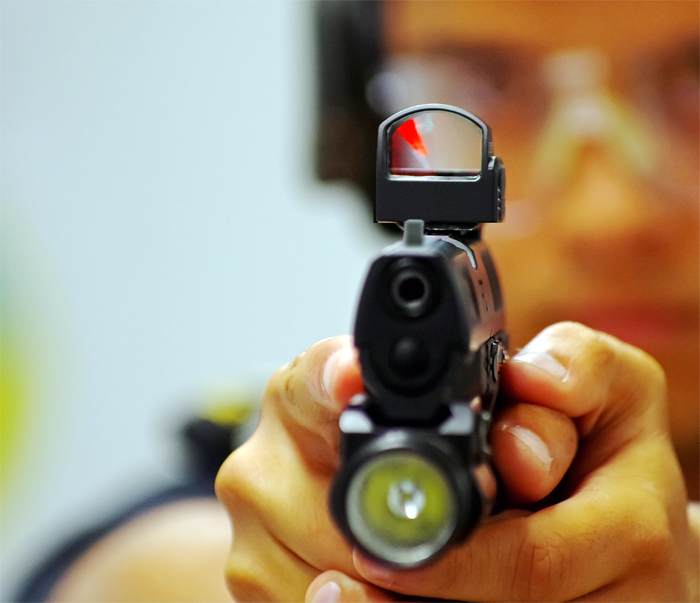
Some officers may see a cluster of small dots instead of one clear dot. This is from astigmatism in the eyes, and is a function of aging eyeballs that very slightly lose their perfectly round shape over the years. Corrective lenses can help with astigmatism, but in practical terms, it will not usually affect accuracy. Red dot sights are probably the greatest single technological advancement in shooting since the invention of cartridges in the mid-19th century.
Physiology: The Science of Shooting Under Stress
There is a reason why we call the natural physiological reactions of the human body in sudden life-threatening situations, the fight/flight/freeze syndrome. In the middle of sudden incidents, the conscious mind tends to shut down or limit its ability to process multiple inputs of information. This is why modern training should emphasize dynamics, movement and unusual situations, but still concentrate on the basic skills that are practiced until they become automatic. Extreme stress tends to create cognitive difficulties and impairs our ability to make decisions. This is why training doesn’t stop on the shooting range or during In-Service sessions. Every day administrative tasks such as the simple act of loading a pistol, should also closely duplicate our emergency manipulation skills.
"Graphs don't stop gunfights. The best battle will always be the one that is never fought in the first place."
Can we improve upon statistics that show how quickly accuracy deteriorates in sudden encounters? Well, graphs don't stop gunfights and the best battle will always be the one that is never fought in the first place. But when there are no other options, we no longer have the choice to fight, flight or freeze. With modern training, a concentration on the basics through constant repetition to imprint those skills into our unconscious and with improvements in technology, that sidearm becomes like a parachute; when you need it, nothing else will do. We just want to make sure it is packed right.
****
Based in Winnipeg, Canada, Dave Brown is a professional firearms instructor and one of few civilians in Canada considered an expert in police weapons training. He has worked with military, police and government agencies on advanced shooting skills, been an Expert Witness in court, lectured at the University of Manitoba School of Law and addressed the Standing Committee on National Security at the House of Commons in Ottawa. As subject-matter-expert in the design of the Canadian Firearms Safety Course program, he helped write the book on firearms safety in Canada. Dave has written over 80 magazine articles that were published in a wide variety of police and trade magazines.